June Primary Preview: A First Draft
A once sleepy June Primary in the East Bay is now brimming with competitive races and interesting storylines to follow


☕️MORNING BUZZ
Vol. VI, No. 1,174
—We’re 134 days from the June primary. It sounds like plenty of time. It isn’t.
That reality was on full display this weekend in Hayward, where four Democrats running for Congress and the state Senate jockeyed for the state party’s coveted endorsement—an early prize in races already taking shape.
Never mind that the March 6 filing deadline is still more than six weeks away. In a primary, momentum forms fast, and it can vanish just as quickly.
—But with the June primary now officially underway, here’s an early preview:
—BIG 3+1—By mid-November, the June primary was shaping up to be an epic snoozer. Not a single county, state, or federal race appeared meaningfully contested.
—That changed when Rep. Eric Swalwell announced a run for governor, opening his congressional seat and setting off a brief round of political musical chairs that ultimately put State Sen. Aisha Wahab’s seat in play this June.
—Soon after, recalled Alameda County District Attorney Pamela Price declared a bid to reclaim her job from her appointed successor, DA Ursula Jones Dickson. And now, a fourth potential sleeper race is emerging in the Fremont–South Bay’s 24th Assembly District.
The Big 3
14TH CONGRESSIONAL DISTRICT
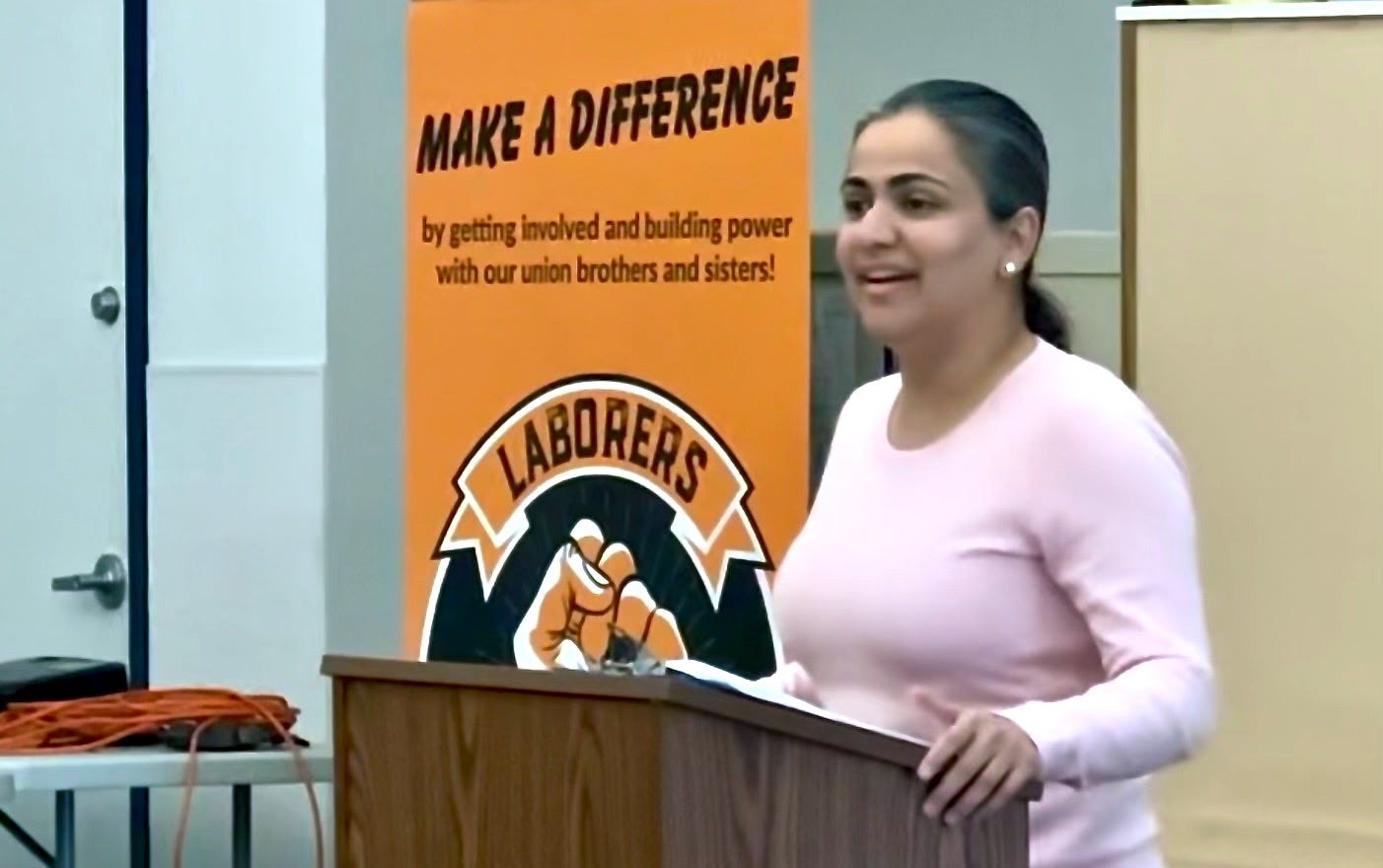
As of now, six Democrats and two Republicans have declared their intent to run in the 14th Congressional District, which spans Hayward, the Tri-Valley, and the Tri-Cities. The field is led by State Sen. Aisha Wahab and BART Board Director Melissa Hernández, the former mayor of Dublin.
Wahab enters as the clear frontrunner, with the deepest legislative résumé in the race and experience that extends well beyond local government. Hernández occupies the more moderate lane, though her policy positions remain underdeveloped. Still, the Tri-Valley has historically proven decisive: it powered Eric Swalwell to Congress the last time the seat was contested, in 2012 and 2014, when the Dublin native and former councilmember defeated “over-the-hill” opponents Pete Stark and Ellen Corbett.
Wahab is a formidable candidate. She is easily the strongest extemporaneous speaker in the field and is well positioned to attract major statewide labor support.
How the rest of the field reshapes the top-two primary remains an open question. Democrats Matt Ortega and Victor Aguilar Jr. appear to be running as progressives, potentially siphoning votes from Wahab.
At the same time, Latinos make up a significant share of the electorate, particularly in Hayward. Four Latino surnames on the ballot complicates Hernández’s path, especially in a low-information primary where many voters rely heavily on names, ballot designations, and party labels.
The most likely outcome is a Wahab-Hernández matchup in November—a familiar progressive versus business-friendly candidate contest. If that happens, expect an expensive and bruising general election, driven by independent expenditure committees, much like Wahab’s expensive 2022 State Senate race against Lily Mei.
10TH STATE SENATE DISTRICT
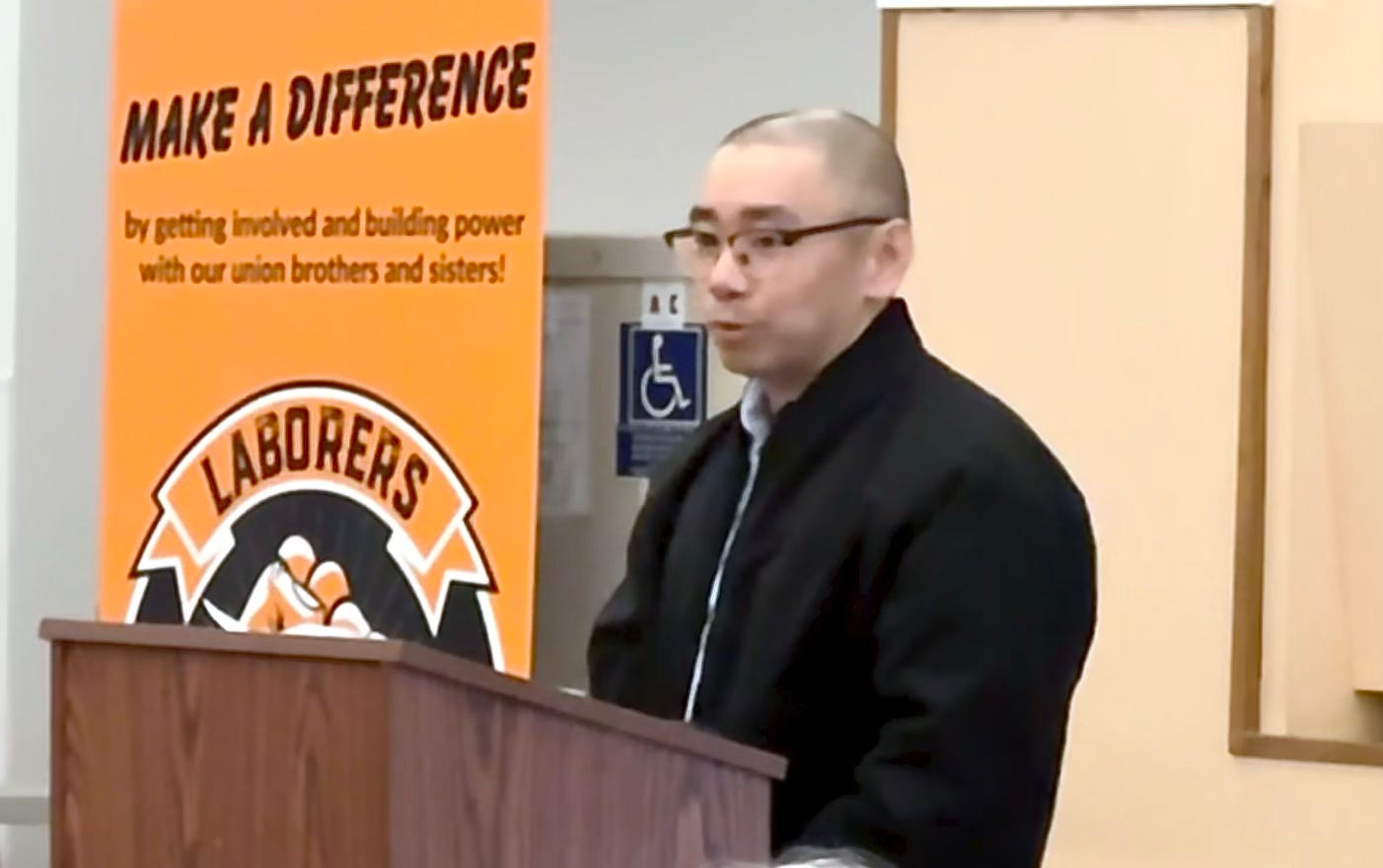
Scott Sakakihara, a little-known Union City councilmember, is emerging as the early frontrunner in the 10th State Senate District primary, largely because of money. Sakakihara has personal wealth and appears willing to spend heavily, having already pledged $250,000 to seed his campaign, with rumors of far more available.
At Saturday’s Alameda County Democratic Party event, delegates seemed genuinely impressed with Sakakihara. The enthusiasm, however, is notable given a potential contradiction: his employment history with Palantir, a tech firm widely criticized by Palestinians and their supporters, sits uneasily with a local party that has previously passed a resolution labeling Israel’s occupation of Gaza a genocide.
Sakakihara did not avoid the issue. He said he recently left Palantir because of the company’s cooperation with ICE and devoted roughly a third of his five-minute speaking slot to explaining his ties to the firm and his subsequent departure. Still, his rationale left gaps that his Democratic opponents are likely to exploit. Ahead of Saturday’s pre-endorsement caucus, one rival, Milpitas Mayor Carmen Montano, circulated a message to delegates highlighting Sakakihara’s Palantir connection.
The race also includes Democrats Harris Mojadedi, a Chabot–Las Positas Community College trustee, and former South Bay Assemblymember Paul Fong. Linda Price, a Republican from Santa Clara County, has also filed to run for the seat.
ALAMEDA COUNTY DISTRICT ATTORNEY
In a short period of time, appointed Alameda County District Attorney Ursula Jones Dickson has been credited with at least stopping the office’s slide into dysfunction. She has also consolidated strong support among county leaders and city officials alike—helped, no doubt, by the fact that former DA Pamela Price was even more unpopular with local elected officials than with the 64 percent of voters who recalled her in November 2024.
Price’s decision to seek her old job back briefly jolted the race last month. Like any appointed incumbent, Jones Dickson had hoped to face little or no opposition in an election that would set the office’s direction through 2028. In the meantime, Price has largely gone radio silent. How she plans to raise money for what is, at best, a long-shot comeback remains unclear, and attempting to nationalize the race by running against President Trump appears misguided.
The contest will draw attention, but the central question is whether Jones Dickson can win the two-year term outright in June by clearing 50 percent. That remains the most likely outcome. Still, despite her track record, Price appears to retain a loyal bloc—perhaps 25 to 30 percent of the electorate. Absent Price, Jones Dickson could have banked campaign cash and used this June Primary to build a war chest for the 2028 election, when the seat will be contested for a four-year term.
Sleeper Race
24TH ASSEMBLY DISTRICT
After briefly flirting with a run for the open 10th State Senate seat, Assemblymember Alex Lee has opted to seek re-election—and he is likely to face a serious challenge from Fremont Councilmember Yang Shao, a blunt, no-nonsense opponent who could create real problems.
Lee’s decision to stay put is probably a shrewd one. Few legislators of his stature have been as fortunate at the ballot box. In 2020, he slipped into the top-two primary with just 15 percent of the vote in a crowded field, then coasted to victory against a Republican in a heavily Democratic district. He faced—and defeated—the same Republican in the two subsequent elections. While Lee is a reliable progressive with strong labor ties, he has never been tested in a truly competitive race.
Shao is a Democrat in registration only, at least in the eyes of many district voters. His record and rhetoric skew decidedly moderate to conservative, and he is not one to shy away from confrontation. Any momentum Shao gains, however, would quickly make his past statements a major liability—both for Lee and for the independent expenditure campaigns likely to rally to Lee’s defense.
Shao has been outspokenly hostile toward homeless residents in Fremont and once drew criticism for remarks as a school board member that disparaged Martin Luther King Jr., suggesting the civil rights leader was a philanderer.
Rest of the Ballot
BOARD OF SUPERVISORS
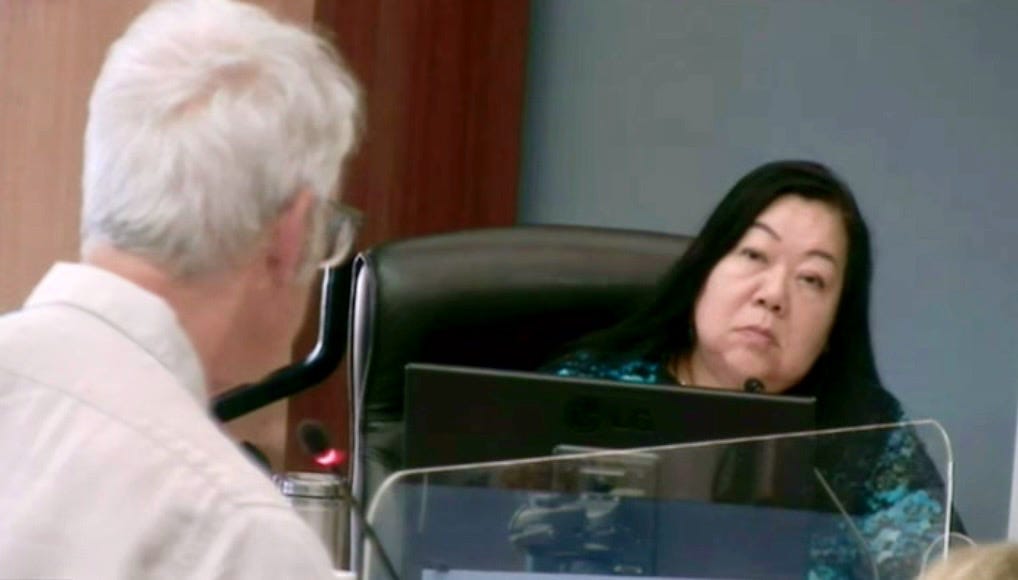
Two of the five seats on the Alameda County Board of Supervisors are on the ballot this June, and neither incumbent—Supervisors Elisa Márquez or Lena Tam—has yet to draw a challenger. That’s a missed opportunity for progressives, who narrowly lost control of this historically left-leaning board.
This election cycle offered a plausible path to flipping the majority. Tam, in particular, is often the swing vote, positioned between Márquez and Supervisor Nikki Fortunato Bas on the left and the board’s moderate bloc, led by Supervisors Nate Miley and David Haubert. More often than not, Tam sides with the moderates.
Supervisorial races are notoriously expensive, and incumbency carries significant weight on this board. The progressive majority was only broken because two supervisors died roughly three years ago—making the lack of challengers this year all the more consequential.
BOARD OF EDUCATION
Alameda County, like many others, is grappling with serious budget problems at the school district level. Nearly every district in the county was forced to close a deficit last year, and two—Oakland and Hayward—are now teetering on the brink of state receivership. Despite the deteriorating fiscal outlook, there has been no surge of candidates eager to push for change at the Alameda County Board of Education. County Superintendent of Schools Alysse Castro is running unopposed, as are the three incumbent trustees seeking re-election: Joaquin Rivera in the Albany–Berkeley–Oakland seat, Aisha Knowles in the district covering the unincorporated areas, and Cheryl Cook-Kallio in the Tri-Valley and Sunol seat.
CONGRESS
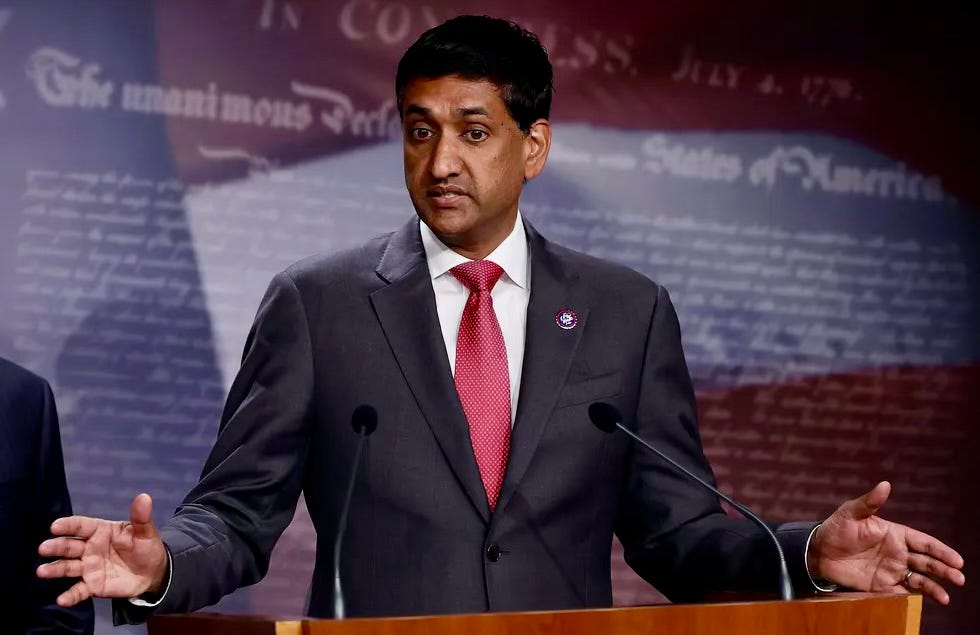
Similarly, three Democratic incumbents in the East Bay are expected to sail to re-election this year, although there are rumors that Rep. Ro Khanna may have a billionaire challenge him in the primary. Khanna, though, is very popular in Fremont and Silicon Valley. Any whiff of a challenge could actually help his already prodigious fundraising and boost his standing as a potential presidential candidate in 2028. Reps. Lateefah Simon and Mark DeSaulnier round out the East Bay congressional district.
ASSEMBLY
The four remaining Assembly races in the East Bay are led by Democratic incumbents who are unlikely to face serious opposition this year. Buffy Wicks, Mia Bonta, Liz Ortega, and Rebecca Bauer-Kahan are each drawing early challengers from the Republican and Green parties, and unknown Democrats. All of the incumbents, except Wicks, are facing familiar opponents from the 2024 election.

—411 ON THE 510—Become an East Bay Insiders subscriber today and get FULL ACCESS to the inside scoop every weekday morning at 6 a.m. It’s what the insiders read.
🙏To all the new subscribers who joined the East Bay Insiders last year and the 3️⃣ million visitors in 2025. Thank you for your support!